In August I travelled around Bulgaria with a half-frame camera and three rolls of Harman Red — a redscale 35mm stock that turns ordinary daylight into deep orange, amber, and near-black shadow. One week. Three rolls. Roughly a hundred and fifty frames of mountains, mist, huts, and the kind of grain you only get when you ask a small negative to carry a big landscape.
This is not a lab-chart review. It is a field test: what Harman Red looks like when you walk all day, when the weather turns soft, and when you stop caring about “correct” colour and start chasing mood instead.


Why half-frame + Harman Red
Half-frame doubles your frames per roll and forces a tighter, often vertical rhythm. Pair that with Harman Red and you get twice the chances to learn how the stock behaves — and twice the grain when you enlarge. For hiking photography that is a fair trade: more chances at weather, light, and small human details without carrying a bag of film.
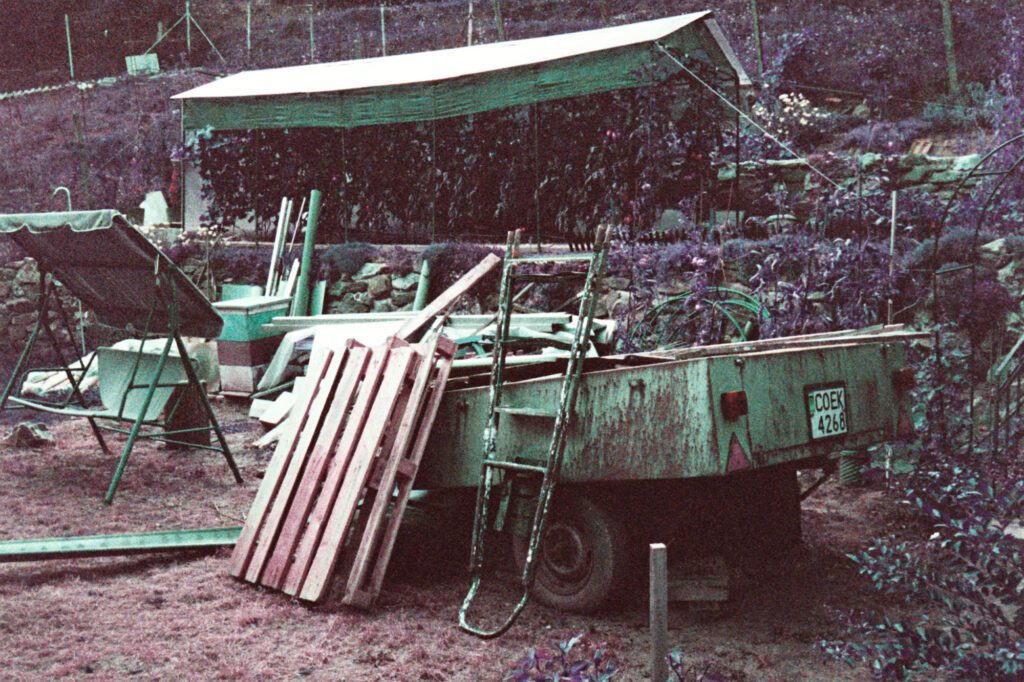
Harman Red is built for the redscale look: light hits the film base first, so blues collapse and warm tones surge. Highlights bloom. Shadows go dense. Landscapes start to feel a little like Mars — which, on a Bulgarian ridge in late summer fog, is exactly the point.


Roll one: fog, ridges, and a hut in orange
The first roll lived in soft weather — the kind that erases the horizon and leaves only shape. Peaks dissolved into orange fog. Trails became dark ribbons. A stone hut under a jagged summit looked like a still from a film that never needed a set designer.


Camping frames on Harman Red are unforgiving and generous at the same time: tents and wooden bridges sit as small human marks inside a huge warm field. If you want “pretty blue sky,” this is the wrong stock. If you want atmosphere you can feel in your chest, keep walking.


Roll two: silhouette, halation, and simpler shapes
By the second roll I started simplifying. Harman Red rewards graphic frames — a black ridgeline, a glowing sky, a hard edge of scrub. The stock’s halation (that red bloom along bright edges) becomes part of the composition, not a flaw to edit out.


Roll three: rock texture and closer ground
The third roll stayed lower to the ground — lakes, scree, cliff faces, the texture of stone that half-frame grain loves. When the sky goes flat orange, the rocks become the story: edges, cracks, and the small plants that cling on anyway.


What I would tell you before you buy a roll
Expose generously if you want shadow detail — Harman Red goes dense fast. Meter for the subject you care about, not the glowing sky. Embrace the grain: half-frame plus redscale is not a “clean” look, and that is the pleasure of it. Shoot sequences, not single heroes. The story lives in the walk between frames.
If you are searching for Harman Red film samples, half-frame redscale photography, or simply proof that three rolls can still feel like a small expedition — this is what one week in the Bulgarian mountains looked like when the colour went entirely its own way.
Nothing beats a long walk, a pocketful of film, and time spent looking. The scans are just the receipt.